
Industrial Utility Efficiency

Aeration Blowers

Most-Open-Valve (MOV) control is a common automatic dissolved oxygen (DO) control system. By reducing the required aeration blower discharge pressure, MOV can improve basin efficiency and reduce power requirements if the MOV and aeration blower controls are properly coordinated.

Aeration Blower Control Efficiency

Blower manufacturers are the source for the most accurate information on aeration blower power consumption. This includes the impact of various control technologies on the many types of blowers used for aeration. However, system designers often need to analyze several alternatives, making reliance on input from suppliers inconvenient. An understanding of the principles of operation will also enhance the designer’s ability to assess the data received from various sources.

Blower Requirements with DO Control

The capacity and pressure requirements of blowers in a Water Resource Recovery Facility (WRRF) are determined by the aeration system. When systems are manually controlled blowers often operate at constant flow and pressure day in, day out. When the aeration system is automatically controlled to maintain a set dissolved oxygen (DO), however, the blower’s flow and system pressure vary constantly. Understanding these variations will help designers and suppliers optimize blower performance.

Busch Provides Reliable Oxygen Supply to Aeration Tanks

The Wastewater Association of Rheinfelden-Schwörstadt operates the wastewater treatment facilities in Schwoerstadt and Rheinfelden-Herten, Germany, as well as several rainwater overflow basins. This wastewater treatment facility now satisfies the highest requirements, and with a population of about 47,000, has reached a size that also guarantees sufficient disposal capacity for future generations.

Aeration Blower Turndown

Blower efficiency is a justifiable concern during the design and selection of aeration equipment. However, efficiency may not be the most important consideration in aeration blower applications. In many cases the blower with the highest efficiency will not provide the lowest energy consumption! Blower turndown is a parameter that is generally more important than efficiency in optimizing energy use.

Aeration Blower Requirements

Aeration blowers receive a lot of attention from design engineers, suppliers, and end users. That is understandable since blowers account for more than 50 percent of the energy used in a typical wastewater treatment plant (WWTP). They represent “low hanging fruit” for energy conservation measures in wastewater treatment!

Adopting PillAerator High-Speed Turbo Blowers for Yeast Fermentation

Yeast fermentation is a vital process in the production of many food and beverage products. It is a common application within breweries, bakeries, and wineries, along with other facilities where biogas and ethanol are produced. In these facilities, fermentation tanks filled with a reaction liquid are often supplied with air from blowers. Recently, there has been a trend in the adoption of high-speed turbo blowers for yeast fermentation applications, as the blower technology can yield large energy savings if properly installed and controlled.

Sewage Treatment Plant Retrofits Diffusers to Cut Energy Consumption 50%

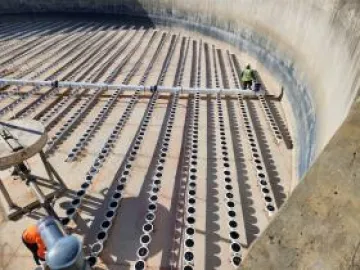
The Ilmajoki sewage treatment plant (STP) located in southern Finland was built in the mid-1970s during a boom of infrastructure construction. Over time, industrial presence in the Ilmajoki area grew, and the plant saw an increase in flow of industrial effluent—or liquid waste and sewage. As the amount of influent increased, the plant was no longer able to meet required performance criteria suffered from a severe lack of oxygen—particularly during peak loading times.

Hoffman & Lamson: Engineered-To-Order Multi-Stage Centrifugal Blowers

Hoffman & Lamson has been manufacturing multi-stage centrifugal blowers for a long time. Lamson was founded in 1880, and Hoffman was established in 1905. Now a single entity under the Gardner Denver Nash Division, the company has some serious resources to complement its 100-plus years of blower expertise.

Turbo Blowers Generate Significant Energy Savings at Victor Valley Wastewater

A replacement strategy for air compressors and blowers integrated into a system-level approach towards energy efficiency can deliver significant energy savings and optimize equipment performance. At the Victor Valley Wastewater Reclamation Authority, a blower replacement project yielded annual energy savings of more than 928,000 kWh and $98,000 in energy costs, while improving the reliability of its secondary treatment process. In addition, the agency qualified for important incentives from its electric utility — significantly improving the project economics and resulting in a 2.94-year payback.

Pneumatic Control in Modular Wastewater Treatment Plants

The design of wastewater treatment plants is changing, and it has something to do with LEGO® bricks. More specifically, it has to do with how large and complex LEGO structures are built. If you follow the instructions carefully, you build module after module, eventually piecing them together to create a fully functional and cohesive unit.