Most-Open-Valve (MOV) control is a common automatic dissolved oxygen (DO) control system. By reducing the required aeration blower discharge pressure, MOV can improve basin efficiency and reduce power requirements if the MOV and aeration blower controls are properly coordinated.
The main goal for operators is to maintain optimal DO levels. Insufficient aeration can lead to poor treatment, while over-aeration wastes energy without improving results. Since aeration can account for as much as 50 to 70% of a wastewater treatment plant’s total energy use, avoiding excess air delivery is critical to overall energy efficiency. MOV addresses this by delivering only the air needed where it’s needed and at the right time, maximizing performance and efficiency.
While MOV control offers significant energy savings and process stability through advanced air distribution strategies, its full potential can be realized when paired with high-efficiency diffuser technologies, such as fine bubble diffusers.
These systems not only require less air and energy to operate, but also provide a high oxygen transfer efficiency (OTE), making them highly efficient for delivering oxygen to the biological process. Integrating fine bubble aeration with advanced MOV-based control strategies enhances both energy efficiency and biological process stability. This combination allows for more precise DO management and can lower aeration blower energy consumption by up to 40% compared to conventional aeration and control methods.
MOV Integrated in a Multi-Basin Aeration System
The control system must integrate all the process variables associated with the aeration requirements for each basin. Air flow demand must be controlled between basins. This is done by redirecting the aeration requirements between the basins. Although controlling the air flow of the blowers is the primary consideration, a variety of other parameters such as DO, mixing limitations, flow control valve characteristics and safe aeration blower operating ranges must also be considered.
An aeration system design based on traditional control strategies and standard control products may be the reason the existing basin control system is not effectively controlling the DO aeration process. Ultimately, the biological health of the basin depends on maintaining a balanced and consistent DO profile that supports aerobic microbial activity without over- or under-aerating. Failure to manage these factors is a leading reason many DO control systems underperform or fail to deliver anticipated energy savings and process outcomes.
DO control systems have the additional challenge of being a non-linear process. The combination of slow process reaction rates, transport delays and the ability to hold DO during process variations, such as weather events, makes it difficult to achieve stable control with typical Proportional–Integral–Derivative (PID) systems. This is where the Basin control algorithm comes into play. It eliminates the complexity, tuning and potential hunting issues associated with pressure control-based systems, while remaining responsive to process demand changes.
Today, basin aeration is commonly done using control valves. As the basin experiences changes in DO concentration, control valves adjust air flow to control the DO for each basin or control zone. To lessen the impact of control valves and the non-linear nature of control valves, blower control systems have relied on maintaining constant pressure.
MOV logic was introduced to not only eliminate excess system pressure, but also improve DO control in multiple basins and eliminate the complexity of tuning and potential hunting issues associated with pressure control valve-based systems. The function of MOV is keeping basin flow control valves in the most open position at all times to reduce restriction and pressure drop.
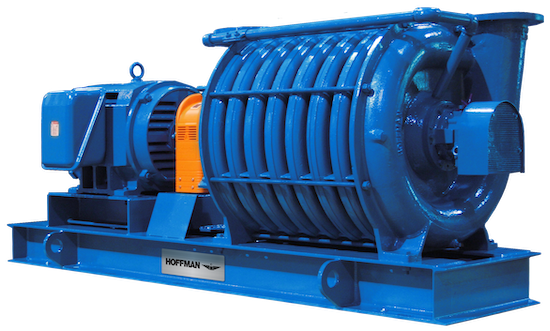
This medium-flow, multistage centrifugal blower is meant for water, wastewater and industrial air applications.
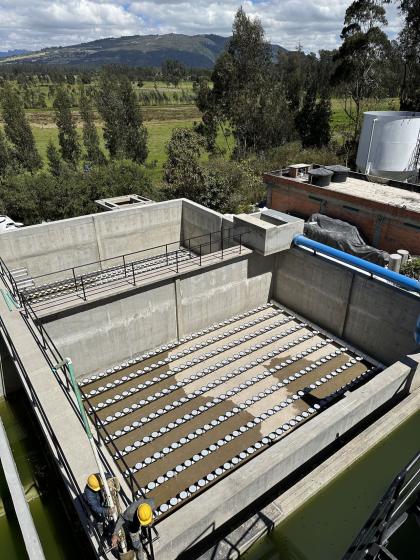
A diffuser installation in Colombia using advanced membrane materials.
Future-Proofing with Advanced Control Strategies
There has been an evolution in how MOV has been implemented. The first implementation was through pressure management by manipulation of the pressure set point. By moving away from pressure set point and using the basin flow control valves, there was an increase in additional tuning and instability. This reduced tuning issues, providing a more stable process and more accurate and optimized power consumption than systems based on general-purpose hardware and generic logic.
Wastewater treatment operators are faced with many challenges. Reducing operating budgets, increasing plant operating efficiency, staying in compliance and meeting management directives to increase sustainability are just a few. Strategies that improve process stability while lowering energy consumption are no longer just for operational costs, but are essential for climate action.
Implementing control systems such as MOV enables facilities to minimize aeration blower energy demand while achieving precise DO control. When paired with high-efficiency diffuser technologies and optimized aeration blower management, these systems support both operation and sustainability goals.
Upgrading existing facilities with energy-efficient equipment and intelligent control logic is one of the most impactful ways operators can contribute to global sustainability efforts. Whether managing a city plant or treating high-strength waste from food processing or manufacturing, optimized aeration plays a central role in reducing energy consumption and limiting greenhouse gas emissions. Using advanced control strategies such as MOV and high-efficiency diffusers, facilities can meet today’s compliance benchmarks while also future-proofing their infrastructure against increasingly stringent environmental regulations.
How to Implement an MOV Control System
Aeration blowers operate in one of two ways: maintaining set flow rates and allowing pressure variance. If constant pressure is maintained and flow varies, the pressure setting is a problem. Setting system pressure too high wastes energy. MOV is a major step forward in minimizing wasted power.
In pressure-based systems, MOV functions by using the least amount of pressure to achieve proper aeration. Aeration blower control systems have relied on maintaining constant pressure to minimize the impact of valve adjustments on adjacent basins. Previous pressure control systems also used pressure to regulate aeration blowers when demand changes at the tank, causing the basin control valves to modulate.
First, start with all valves open. This results in the least amount of system pressure. The process begins by adjusting the valve at the first basin to meet basin aeration requirements. Continue this process with each basin until all valves are adjusted to meet aeration needs. A change in one basin’s requirements results in adjusting all basins’ valves.
If there is a change in the pressure set point at each basin and a decrease in the pressure by a fixed increment, this would cause a decrease in aeration blower flow rate and total system air flow to drop the pressure. This initiates all basin valves to open to increase their air flow rate. The restriction decrease would drop system pressure, forcing the pressure control loop to increase blower air flow again. After a few adjustments, the system stabilizes to the desired air flow for all basins, reducing system pressure.
When applied correctly, MOV delivers a range of performance, energy and operational benefits that significantly enhance overall plant efficiency. By supplying oxygen precisely as needed according to operator-defined DO set points, MOV systems help maintain optimized and stable biological treatment. This not only improves treatment outcomes, but also minimizes energy consumption, as aeration blowers are no longer overcompensating with excess pressure or flow. The reduced mechanical strain on aeration blowers and valves extends equipment life and lowers maintenance demands.
When MOV control is combined with high-efficiency fine bubble diffuser systems, the results are amplified. Fine bubble diffusers offer significantly higher oxygen transfer efficiency compared to coarse bubble systems, allowing facilities to meet oxygen demand with substantially lower airflow, minimizing the amount of energy needed.
High-efficiency diffusers can be equipped with advanced membrane materials that offer a higher resistance to fouling and scaling. This allows the diffuser to maintain near-original performance over time, reducing the frequency of required maintenance and ensuring consistent oxygen delivery. Over the long term, plant operators who choose an upgraded membrane material will see lower operational expenses.
The combination of MOV control logic and high-efficiency diffuser technology offers a practical approach to improving aeration system performance while addressing current energy, regulatory and operational objectives.
Flow-Based Systems and Fine Bubble Diffusers
Legacy controllers had limitations between devices, whether they were electrical or pneumatic. Modern control technology combines a variety of communications protocols and control functions into one controller. The programming may be more involved, but stability and performance are improved. Total process flow demand is matched with the air flow supplied by multiple aeration blowers and combines multiple process air flows.
Fine bubble diffusers respond effectively to incremental changes in airflow, enabling precise and stable DO control at the basin level. Their uniform air distribution and efficient mixing characteristics minimize the need for high system pressures, which aligns well with MOV strategies aimed at reducing aeration blower discharge pressure.
In MOV-based systems, the controller accesses the position of every valve in a system, making required adjustments to each valve to match the requirement of each basin. This provides control based on actual process needs per basin and uses the aeration blower controls to match total air flow to process demand. It uses basin flow control valves to divide the total air flow to the basins in proportion to their individual demands.
Air is then divided and redirected in proportion to process demand needs per basin. If one basin has excess flow, then another basin will have insufficient flow. The valve at the basin with insufficient flow will open, and, if there is excess flow at another basin, that valve will close to meet that basin’s needs. One valve is always in the maximum open position.
Fine bubble diffusers are well suited to complement flow-based control logic. Pairing the technologies supports greater turndown and more refined load-following capabilities. Together, the system allows the operator greater flexibility in how air is distributed across basins, allowing for tighter control of DO concentrations and more efficient energy usage.
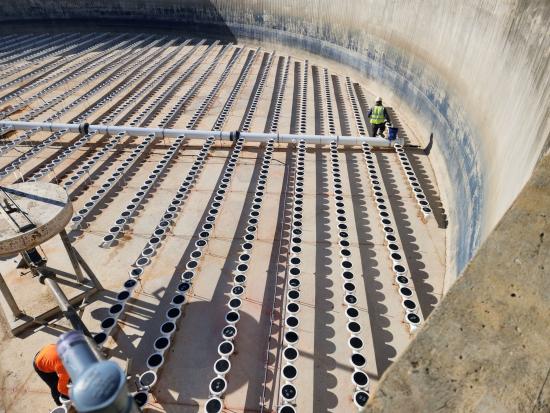
Installation crews installing an SSI disc diffuser aeration system.
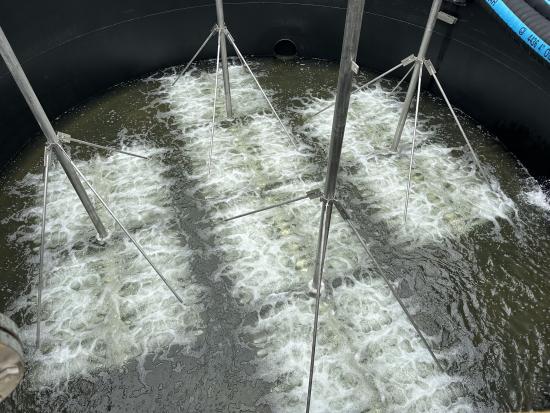
This retrievable aeration grid allows for easy maintenance and monitoring without draining the system.
The Benefits of MOV Control
|
Conclusion: MOV Control Provides a Powerful Framework
MOV has caused uncertainty for designing engineers, programmers and operators. Despite all the misconceptions with MOV and the potential confusion and complexity of applying it, MOV control reduces power consumption by minimizing system pressure drop through basin air flow control valves. MOV can be adapted for basin aeration by maintaining aeration blower discharge pressure or air flow rate.
For a successful MOV system, it is important to synchronize between the multiple components of DO, pressure and flow control. The control of each aeration blower affects the others and should be considered as parts of a system.
The future of energy-efficient wastewater treatment lies in the integration of advanced control strategies with high-performance aeration technologies. MOV control provides a powerful framework for minimizing aeration blower energy use and stabilizing dissolved oxygen delivery by maintaining the lowest effective system pressure. When paired with fine bubble aeration, which offers superior oxygen transfer efficiency at lower airflow rates, the result is a highly optimized aeration system that enhances biological performance, reduces operational costs and supports long-term sustainability goals. Together, MOV and fine bubble diffusion represent a best-in-class approach for modern wastewater treatment – delivering measurable benefits in compliance, energy savings and process stability.
 |
 |
|
Bob Kisler |
Doreen Tresca |
About the Authors
Bob Kisler has over 35 years in the aeration blower industry, concentrating on procedures and process improvement. He focuses on variable frequency drives, PLC controls and programming to reach maximum energy savings and process improvement for aeration blower applications. He provides consultations to develop technical solutions, as well as assistance on energy savings with centrifugal blower technologies.
Doreen Tresca is a strategic marketing leader with over 15 years of experience driving growth for B2B brands in the water and wastewater industry. She currently leads global marketing and communications at SSI Aeration, supporting international sales and operations across the municipal and industrial sectors.
The Bentleyville, PA, home of Hoffman & Lamson.
About Hoffman & Lamson
Hoffman and Lamson are trusted leaders in centrifugal blower and exhauster technology, with over a century of engineering excellence serving water, wastewater and industrial markets worldwide. As part of Gardner Denver’s Nash Division, it offers a broad range of high-efficiency blower systems – customizable, energy-saving and built for durability across demanding air and gas applications. For more information, visit https://www.hoffmanandlamson.com.
About SSI Aeration
With nearly 30 years of experience, SSI Aeration is a global leader in wastewater treatment technologies, specializing in energy-efficient fine bubble diffusers and MBBR systems. Backed by engineering expertise and worldwide support, SSI delivers reliable, innovative solutions that help facilities operate cleaner and smarter. For more information, visit https://www.ssiaeration.com.
To read similar articles on Aeration Blowers, visit https://www.blowervacuumbestpractices.com/technology/aeration-blowers.
Visit our Webinar Archives to listen to expert presentations on Aeration Blowers at https://www.blowervacuumbestpractices.com/magazine/webinars.