Industrial Utility Efficiency

Technology

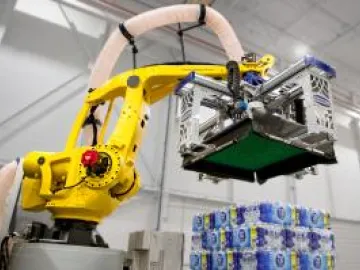
Suction rate, nozzle diameter, degree of evacuation, generator intelligence and air or energy consumption! These are only a few of the factors engineers need to consider when determining the best vacuum generation source for a custom-engineered gripping system. 

From Pharma to Coffee: Pneumatic Conveying Design Basics

It’s one thing to move materials during the production process, but when it’s a finished product on the packaging line, choosing the right material handling system is essential. Getting it wrong results in squandered production time when product loss occurs, and wasted raw materials.

Powdered Egg Company Implements Energy-Saving Pneumatic Conveying System

Nutriom sets the bar high when it comes to producing its premium quality natural powdered egg products Ova Easy® and Egg Crystals®, that are sold at outdoor retailers such as REI, and online merchants such as Amazon.com; so, when the screw conveyor in their FSIS USDA facility required regular unexpected attention, Leonardo Etcheto, Plant Manager at the Lacey, WA facility knew it was time to look for a better solution.

Food Processing Plant Eliminates 734 scfm with Nozzle Upgrade

This food & beverage plant is a large (500,000 sq ft) meat processing plant with twenty packaging lines and nine palletizers. The compressed air system is supplied from three separate rooms with seven individual lubricant-cooled, single and two-stage rotary screw compressors. The plant has four blower purge desiccant dryers designed to deliver a - 40°F pressure dewpoint.

Optimizing Vacuum Generators in Case Packers and Palletizers

This was a complete supply and demand-side system assessment. The supply-side audit involved shutting off old air compressors and purchasing newer more efficient air compressors and dryers. The demand-side audit involved finding ways to improve the piping and reduce compressed air consumption.

Annual plant electric costs for compressed air production, as operating today, are \$3,050,625 per year. If the electric costs of \$27,811 associated with operating ancillary equipment such as dryers are included the total electric costs for operating the air system are \$3,078,436 per year.

Magnetic Bearings: An Attractive Force for Energy-efficiency

With sustainability and energy-efficiency targets tougher than ever, magnetic bearings are drawing the attention of engineers in many industries, offering a whole range of advantages from increased performance to extended lifespan.

Advanced Automation Lowers Labor Cost and Improves Performance at the Las Palmas, California, Waste Water Treatment Plant

Recently the capacity of the Las Palmas, California, waste water treatment operations were expanded by combining two plants and making one centralized filtration center. The new center expanded the flow capacity from 162,000 Gallons per Day (GPD) combined to 288,000 GPD when the manually controlled reclaimed water operations were updated to a state-of-the-art automated system. Reclaimed water from the plant irrigates local community green spaces. The new automated system ensures lower labor costs, consistent quality, and peak efficiency in the process of reclaiming waste water for irrigation.

Evaluating Different Blower Technologies on a Wire-to-Air Basis

In the absence of official third party specifications on energy efficiency, it is difficult to evaluate and compare blower technologies fairly and effectively. The lack of readily available evaluation tools leads to misinformation and unfair comparisons between technologies. Further, the performance verification process is difficult to prove.

Pneumatic Conveying Energy Assessment Saves $321,000

The plant air system consists of eight, single-stage, lubricated, Sullair rotary screw compressors. All units are in good working order.  Units 2, 3, 4 and 7 are water-cooled and units 6, 8, 9, 10 and 11 are air-cooled. The main plant air system has two primary compressed air dryers, a Thompson Gordon model TG 2000 refrigerated dryer, and a Sullair model SAR 1350 heatless desiccant dryer.  Both units are working according to their design. The TG 2000 uses approximately 11.2 kW and is a non-cycling type unit, and the SAR 1350 uses approximately 200 cfm of purge air to regenerate the wet tower. 

Natural Gas Deliquescent Dehydrator Applications

Triethylene glycol (TEG) dehydrators are the most prevalent technology for removing water vapor from natural gas . Molecular sieve dryers are also quite common in gas processing plants. Molecular sieve units have operating processes similar to industrial heat-regenerated compressed air dryers. Natural gas, however, often needs to be purified at the wellhead before reaching the processing plant. Deliquescent dehydrators are normally used, in remote locations where no power supply exists, to dry small gas volumes located between the wellhead and these main treatment plants. The most common applications are instrument gas, fuel gas, sales gas, and emissions mitigation.

Aeration Blowers

Most-Open-Valve (MOV) control is a common automatic dissolved oxygen (DO) control system. By

Air Knives - Nozzles

Blower & Vacuum Best Practices interviewed Republic Manufacturing VP of Sales & Marketing,

Industrial Blowers

One of the most exciting technologies impacting the ability of end-users to optimize blowers at

Measurement

Every municipality and utility is facing the reality of rising energy costs. In 2010, the Town of

Medium/High Vac

The aerospace division of a large industrial manufacturer, uses a large altitude simulation chamber

Purification

In this article, we will isolate and review one system common to many plants and industries: the

Rough Vac

This article examines how industrial facilities can quantify the return on investment associated

Vac Generation

Know Your Vacuum Pump ApplicationKey Vacuum Pump Sizing TermsMoving Different Gasses with a Vacuum