
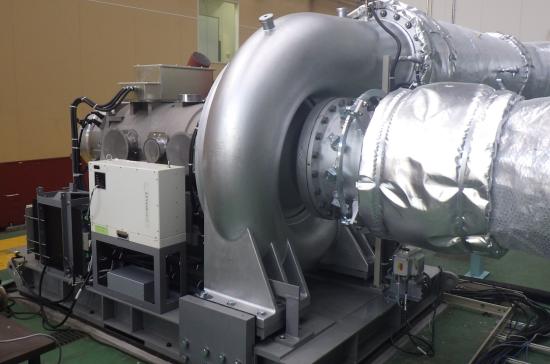
The Kawasaki Heavy Industries MAG Turbo M55 connected to a blower test stand for a wastewater plant project.
A significant objective for aeration system blowers is matching the air supplied to the process demand. Because of variability in process demand, turndown of the aeration blower system is a critical parameter. Of course, it is also important to provide the required air flow at a high efficiency. These two parameters – efficiency and turndown – are critical to system optimization.
Process variability causes system demand to frequently deviate from the design points for flow and pressure. It is common for an aeration system to need a turndown in flow rate of 5:1 or more. This is often accompanied by variations in the discharge pressure. It is not unusual for the actual discharge pressure to be 1.0 psig lower than the design point.
Aeration blowers must operate across a wide range of inlet densities, and the changes in inlet conditions impact aeration blower performance. Density variations are primarily due to differences in ambient temperatures encountered.
This combination of varying demands presents a challenge to aeration blower suppliers. The design point is usually selected to ensure operation in worst case conditions. However, evaluating performance at the design point is only one consideration. During aeration blower selection it is also common to evaluate performance at multiple air flows, discharge pressures and inlet conditions. The assumed duty cycle is intended to reflect the anticipated operating range. This, in turn, is used to estimate the life cycle cost of operating the aeration blower.
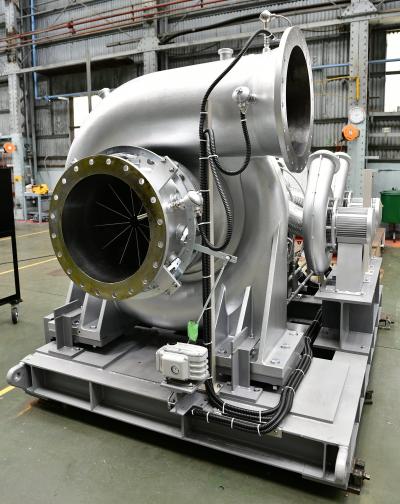
The Kawasaki Heavy Industries MAG Turbo M55.
The Difference in Single Point and Dual Point Control
Single stage centrifugal aeration blowers have established a reputation for reliability and efficiency. They are commonly applied to supply air to wastewater aeration basins. These aeration blowers are available in both geared and direct coupled (turbo) configurations.
There are a number of methods employed in modulating the airflow of centrifugal aeration blowers, including:
- Inlet throttling, typically using a butterfly valve (BFV)
- Variable inlet guide vanes (IGV)
- Variable discharge diffuser vanes (VDV)
- Variable speed, typically using a variable frequency drive (VFD)
Each of these methods is typically employed separately. This is referred to as single point control. It is also possible to combine two of these methods in a single blower. This is referred to as dual point control. The objectives of dual point control are to provide high turndown and good efficiency while operating at flows and pressures differing from the design point.
Historically, the most common dual point control has been combining inlet guide vanes and variable discharge diffuser vanes. These are both mechanical systems and predate the availability of economical variable speed control.
Recent advances in power electronics technology and improved VFD economics have led to implementing other combinations for dual point control. These include combining VFD control with either VDVs or IGVs.
Aeration Blower Control Techniques
A common aeration blower performance curve plots discharge gauge pressure and inlet volumetric flow at a specific set of conditions. All control methods shift and change this aeration blower performance curve. This results in changing the intersection point of the performance curve with the system pressure curve, modulating the flow rate. Each method has a different effect on the performance curve.
Throttling with a BFV results in a lower and steeper curve. This method is inherently inefficient. It wastes power by creating a pressure drop across the inlet valve. However, it has the lowest initial cost.
The result of IGV control is lower pressure and air flow rate, shifting the blower curve downward and to the left. IGVs change the operating characteristics of the impeller by swirling the air ahead of the impeller. As the IGVs close they present a growing obstruction to air flow, resulting in a throttling effect. This results in some inefficiency and also makes the curve steeper.
VDVs change the conversion of velocity pressure to static pressure in the aeration blower volute. VDV control shifts the aeration blower curve to the left, resulting in a lower airflow for a given pressure.
Using a VFD for control moves the performance curve down and to the left but does not induce any throttling. Varying the blower operating speed is the most efficient method of flow modulation. Centrifugal blowers follow the affinity laws. These dictate that flow is proportional to speed, pressure is proportional to the square of the speed, and power is proportional to the cube of the speed. With VFD control, minimum speed is often limited by the discharge pressure capability at reduced speed.
Calculating the Benefits of Dual Point Control
One example of advanced dual point control is the MAG Turbo from Kawasaki Heavy Industries. This design combines IGV and VFD control. It uses a proprietary control algorithm to coordinate the two mechanisms in the dual point control system. The algorithm optimizes the combination of rotational speed and IGV opening in response to fluctuations in flow rate, inlet conditions and discharge pressure. The effect of combining IGV and VFD into dual point control is improved turndown while maintaining high efficiency.
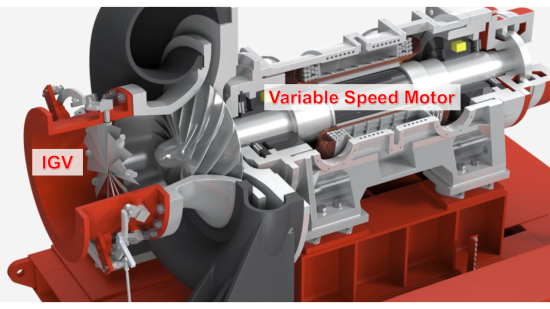
An aeration turbo blower with dual point control.
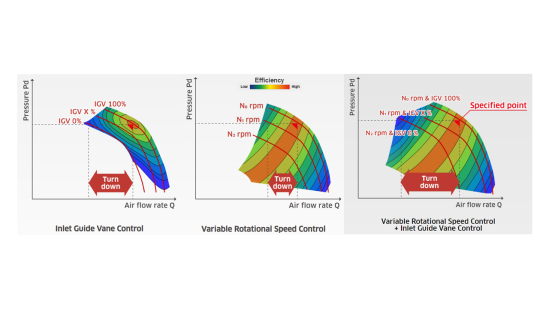
The effect of combining control techniques on aeration blower performance curves. Click to enlarge.
The impact of dual point aeration blower control on off-design operation can be illustrated by an example application. The design point provided by the end user for aeration blower selection was 25,000 scfm (708 sm3/min) at 9.5 psig (0.7 barg) discharge pressure with 14.7 psia (1.014 bar) ambient pressure. Design point inlet conditions were 98°F (37°C), 14.4 psia (0.993 bar), and 40% relative humidity corresponding to the worst case.
The end user also provided a variety of anticipated flows, pressures and inlet conditions for evaluating life cycle cost.
A set of dimensionless performance parameters were developed by the manufacturer from test data. These parameters were interpolated to calculate the performance at the design point and alternate evaluation points. Separate calculations were made for IGV control, VFD control and dual point control. (See Table 1.)
Centrifugal aeration blower turndown is limited by the possibility of surge. Surge is a damaging pulsation in flow rate and pressure that occurs when the system pressure is greater than the aeration blower is able to produce. If the aeration blower’s minimum flow exceeds the process demand it is necessary to waste the excess air by venting it to atmosphere through a blow-off valve. This is an inefficient method of flow control. As indicated in the table, opening the blow-off was required for several evaluation points when controlling with only IGV or VFD. Because of the improved turndown with dual point control, the blow-off was not needed.
Table 1: Performance Data at 14.7 psia (1.014 bar) Ambient Pressure, 40% Relative Humidity
|
Parameter |
|
||||
|
Flow, scfm |
12,500 |
15,625 |
18,750 |
21,875 |
25,000 |
|
Inlet temperature,°F |
23 |
32 |
50 |
50 |
68 |
|
Inlet press. psia |
14.6 |
14.6 |
14.6 |
14.5 |
14.4 |
|
Discharge press. psig |
9.5 |
9.5 |
9.5 |
9.5 |
9.5 |
|
Input power with IGV alone, kW |
659 Blow-off Open |
644 Blow-off Open |
701 |
784 |
892 |
|
Input power with VFD alone, kW |
649 Blow-off Open |
655 Blow-off Open |
672 Blow-off Open |
737 |
868 |
|
Input power with dual point control, kW |
469 |
557 |
654 |
737 |
868 |
The results demonstrate that dual point control combining an IGV and a VFD provides more turndown than either IGV or VFD control alone. The data also shows power consumption at the alternate evaluation points is improved by dual point control. This is particularly true in the low flow range because the improved turndown eliminates opening the blow-off valve.
The end user provided an assumed time of operation for each alternate evaluation point. This information was used to estimate the total annual power consumption for each point.
Table 2: Estimated Annual Power Consumption
|
Hours per year |
438 |
1752 |
3066 |
2190 |
1314 |
Total kWh |
|
Annual kWh, IGV alone |
289,000 |
1,128,000 |
2,149,000 |
1,717,000 |
1,172,000 |
6,455,000 |
|
Annual kWh, VFD alone |
284,000 |
1,148,000 |
2,060,000 |
1,614,000 |
1,141,000 |
6,247,000 |
|
Annual kWh, dual point control |
205,000 |
976,000 |
2,005,000 |
1,614,000 |
1,141,000 |
5,941,000 |
Dual point control reduces the calculated annual power consumption by 8% compared to IGV alone. Compared to VFD control alone the savings are 5%. If electricity cost is $0.10/kWh, dual point control reduces the annual cost of electricity by $30,000 compared to VFDs alone and by $50,000 compared to IGVs alone.
Conclusion
Aeration blowers are critical process equipment in aeration applications. Optimizing energy consumption is a significant objective in selecting aeration blower system technology. Reduced energy use lowers operating costs while enhancing sustainability through reduced CO2 emissions from power generation.
Turndown is key to matching aeration blower output to process demand. Good turndown is essential for both process performance and energy efficiency.
In addition to supporting variations in air flow demand, the aeration blower must accommodate a wide range of operating conditions. The variations in inlet density from ambient temperature changes add to the difficulty of optimizing performance. The control system design will influence turndown and efficiency when the aeration blower operates off the design point.
Dual point control has been used for many years. Originally dual point control was mechanical, combining IGV and VDV. Advancements in technology have resulted in the availability of low-voltage and medium-voltage VFDs for economical speed control. These improvements have led to the use of variable speed operation as part of dual point control strategies. A dual point control system provides excellent turndown at high efficiency, both keys to optimizing aeration blower applications. Innovative systems that combine variable speed and guide vanes provide better performance, improved turndown and higher efficiency than older systems with mechanical controls alone.
About the Authors

Tom Jenkins has over 40 years of experience in aeration blowers and blower applications. As an inventor and entrepreneur, he has pioneered many innovations in aeration blower control. He is an Adjunct Professor at the University of Wisconsin at Madison and a Fellow of the Water Environment Federation. For more information, visit https://www.jentechinc.com/.

Jun Inai is a Senior Design and Project Engineer with over 30 years of experience in R&D and the design of turbomachinery including compressors for air and other gases, blowers and turbines at Kawasaki Heavy Industries. In recent years, he has focused on energy conservation and plant optimization using the MAG Turbo aeration blower.

Hayato Sakamoto leads the Kawasaki MAG Turbo aeration blower project. With over two decades of experience in the development and applications of blowers, compressors for air and other gases, and natural refrigerant chillers, he specializes in the aerodynamic technology of rotating machinery. He designed the highly efficient impellers and diffusers forming the core technology of the MAG Turbo.
About Kawasaki Heavy Industries
With about 100 group companies in Japan and overseas, Kawasaki Heavy Industries is a technology corporate group. Through the development of unique and broad businesses, it solves issues facing customers and society. For more information, visit https://global.kawasaki.com.
All images courtesy Kawasaki Heavy Industries.
For similar articles on Aeration Blowers, please visit https://www.blowervacuumbestpractices.com/technology/aeration-blowers.
Visit our Webinar Archives to listen to expert presentations on Aeration Blowers at https://www.blowervacuumbestpractices.com/magazine/webinars.