Industrial Utility Efficiency

Industries

The Importance of Particle Velocity in Dilute Phase Pneumatic Conveying

In open end pipe line suspension flow, or dilute phase pneumatic conveying, proper particle velocity is critical to continuing productivity and product quality. Until recently, measurement of actual particle velocity within the pipe has not been practical outside the laboratory. The plant operating personnel depend on a much less accurate metric - estimating the conveying air velocity in the pipe and relating that to particle velocity.

Busch Provides Reliable Oxygen Supply to Aeration Tanks

The Wastewater Association of Rheinfelden-Schwörstadt operates the wastewater treatment facilities in Schwoerstadt and Rheinfelden-Herten, Germany, as well as several rainwater overflow basins. This wastewater treatment facility now satisfies the highest requirements, and with a population of about 47,000, has reached a size that also guarantees sufficient disposal capacity for future generations.

The Heart of Pneumatic Conveying Systems - Positive Displacement Blower Calculations

Pneumatic conveying systems are widely used in manufacturing plants and process industries. They provide a practical method of bulk-solid material transport. A surprisingly wide variety of powders and granular material can be effectively moved from one location to another within the plant. “Compared with other bulk-solid transport systems, a properly designed pneumatic conveying system affords many advantages".

Aeration Blower Turndown

Blower efficiency is a justifiable concern during the design and selection of aeration equipment. However, efficiency may not be the most important consideration in aeration blower applications. In many cases the blower with the highest efficiency will not provide the lowest energy consumption! Blower turndown is a parameter that is generally more important than efficiency in optimizing energy use.

Howden Roots DO Control System Optimizes Bird Island WWTP

Bird Island Wastewater Treatment Plant (WWTP) in Buffalo, N.Y., had an inefficient aeration control system that, ironically, had been installed in 1998 as an efficiency upgrade. The operating principle was that air flow to all 32 of the plant’s aeration basins, or zones, would be properly controlled by an average of several Dissolved Oxygen (DO) level measurements taken by DO probes in a few of the basins. However, changes in tank loadings and physical dynamics, along with differences in oxygen transfer rates between diffuser grids, prevented a uniform air flow in the aeration zones.

Black & Veatch Specifications from Diffusers to Blowers - Part 1: The Demand Side - Diffusers and DO Control

Blower & Vacuum Best Practices Magazine interviewed Julia Gass, P.E and Patrick Dunlap, P.E. at the Black & Veatch offices in Kansas City during the summer of 2016. Ms. Gass is responsible for aeration blower specifications while Mr. Dunlap is a wastewater process engineer. We held a general discussion covering technologies impacting aeration blowers in wastewater treatment plants.

Aeration Blower Requirements

Aeration blowers receive a lot of attention from design engineers, suppliers, and end users. That is understandable since blowers account for more than 50 percent of the energy used in a typical wastewater treatment plant (WWTP). They represent “low hanging fruit” for energy conservation measures in wastewater treatment!

Atlas Copco Screw Blowers Save Small Town Big Energy

The wastewater treatment plant in the Town of Hurlock, Maryland provides service to approximately 2,100 residences. However, the majority of the water treated comes from a nearby poultry processing plant, giving the plant influent a high organic content. That is why the Town of Hurlock replaced its two million-gallon-per-day (MGD) lagoon plant with a 1.65 MGD four-stage activated sludge facility ten years ago. After construction was completed, operating costs of the new plant were significantly higher than before. This meant the town had to get creative in order to keep costs down for their ratepayers.

Cabinet Manufacturer’s CNC Routing Tables Switch to a Centralized Vacuum System

Multiple vacuum pumps can be running mostly “dead-headed” in the many production systems that don’t require constant flow.  Any system that evacuates a small volume and then holds a product down while it is being machined, or sucks a bag shut to seal will spend the majority of its time not moving much mass of air.  This type of operation is found everywhere in secondary wood processing, machining, food packaging, and many other industries.  Anywhere vacuum is used as a motive force or to evacuate a small volume repeatedly.  This article will apply to any of these types of systems- and not apply to constant-flow vacuum applications in the process industries.

Austrian Furniture Producer Centralizes Vacuum Supply

ADA Möbelfabrik, headquartered in Anger, Austria, is one of Europe’s largest manufacturers of furniture. Upholstered furniture, beds, mattresses and slatted frames are produced for the Austrian market and for many other European countries in two shifts, using modern manufacturing techniques. The vacuum supply required for securing items to the CNC machining centers is provided via a central vacuum plant produced by Busch. By opting for this vacuum system, ADA has integrated an extremely economical and reliable vacuum supply into the production process.

Food

From managing complex wastewater streams to protecting stored grain and sustaining fish health,

Wastewater

In a strategic move to enhance environmental sustainability and operational efficiency, Universal

Containers

Many manufacturing processes are like offensive linemen. When everything is running smoothly, nobody

Conveying

The 2023 International Powder and Bulk Solids Conference and Exhibition took place April 25-27, 2023

Woodworking

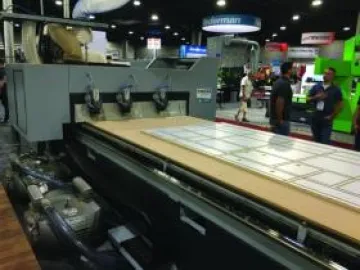
The IWF 2022 International Woodworking Fair was held August 23-26 at the Georgia World Congress

Biogas

Ever since it was commissioned in 1974, the Echallens wastewater treatment plant in the Swiss canton

Energy

Blower & Vacuum Best Practices interviewed Mr. Sid Van der Meer and Mr. Terry Nickel from